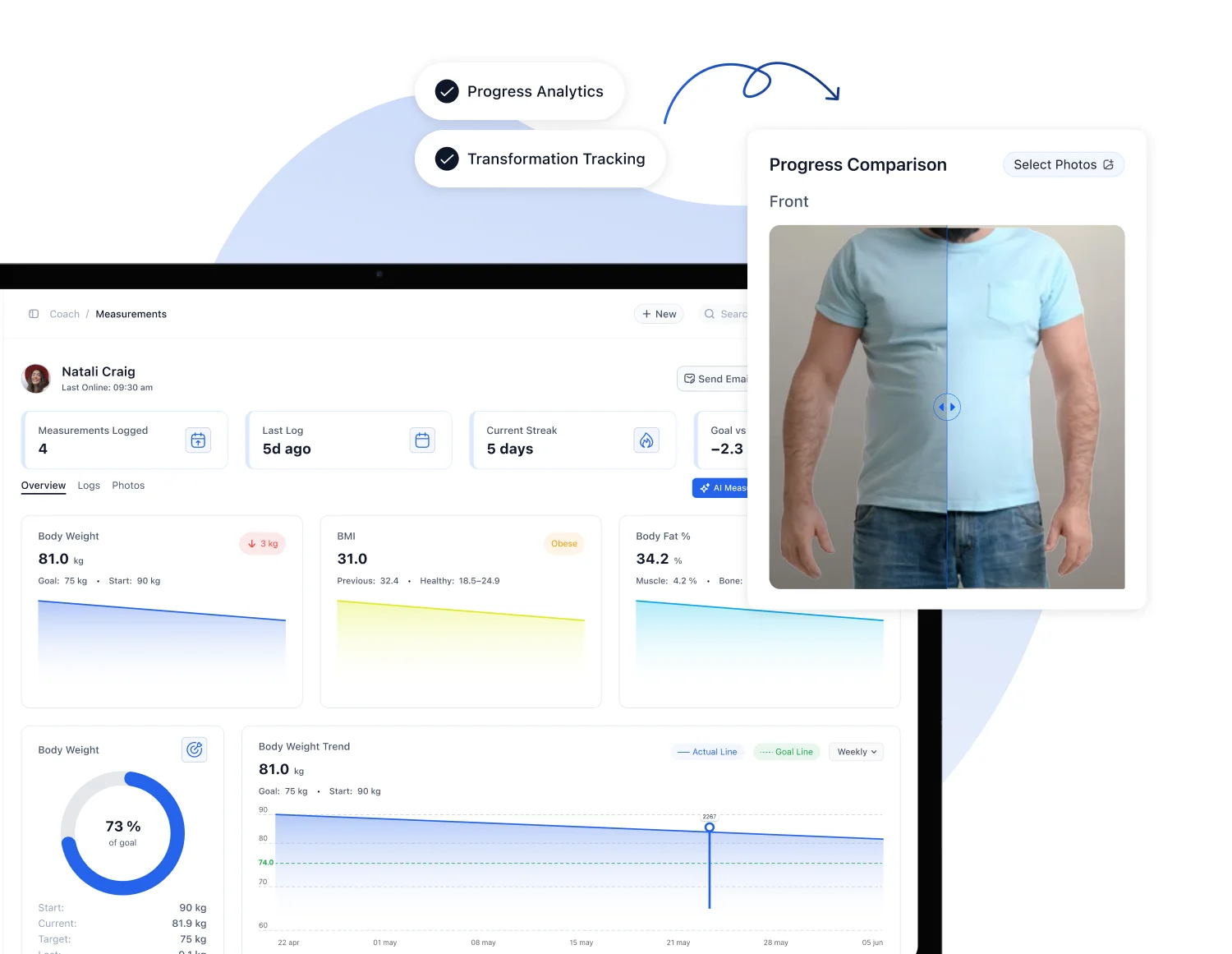
Fitness coaching analytics is the practice of turning client data and business data into coaching decisions. Client data covers training, nutrition, habits and measurements. Business data covers bookings, attendance, memberships and revenue. A metric earns a place on the dashboard only if it changes what a coach does next.
This guide lists the metrics worth tracking, how to review them, and where software fits. A weekly review checklist is included.
TL;DR
- Two layers of analytics: client progress and business operations. Both need a review rhythm.
- Track metrics that change behavior or decisions. Volume alone is not enough.
- Objective logs (habits, activity, measurements) reduce reliance on recall-based reports.
- Software supports the coach. Research on adherence favors human accountability over automation alone.
- FITsociety connects plans, check-ups, progress tracking, bookings, memberships and payments in one environment.
What fitness coaching analytics covers
Two layers.
- Client analytics: training completion, strength and body measurements, nutrition adherence, daily habits, check-in responses.
- Business analytics: bookings, attendance, no-shows, capacity use, membership status, payments, retention.
Coaches who track only one layer see half the picture. A client with strong progress and missed sessions signals a different problem than a client with weak progress and perfect attendance. A studio with full classes and rising cancellations needs a different response than one with empty slots.
The goal is the same in both layers: find the signal early, then act on it.
Why measurement needs a purpose
Sports science researchers describe a framework for test selection that links each measurement to performance outcomes. The framework weighs technical feasibility, decision-making and organizational factors. The point: a test should inform a coaching decision, not just fill a dashboard.
A practical filter for any metric:
- What decision does it inform?
- How often does it need to be measured?
- Can the client supply it without friction?
- Is it measured the same way each time?
If a metric fails the first question, drop it.
Client metrics worth tracking
| Category | Example metrics | Decision it supports |
|---|---|---|
| Training | Sessions completed vs. planned, load, reps, effort rating | Progress or deload the plan |
| Nutrition | Plan adherence, meal logging frequency, weekly averages | Adjust targets or simplify the plan |
| Habits | Steps, water, sleep, daily habit completion | Find the habit behind a stall |
| Body | Weight, circumferences, photos, strength tests | Confirm direction over weeks |
| Check-ins | Energy, stress, soreness, motivation scores | Spot drop-off risk early |
| Fitness tests | Shuttle run, walk test, 1RM or rep-max | Benchmark every 8 to 12 weeks |
Training metrics
Completed vs. planned sessions is the simplest adherence number. Add load and reps for progression. Track trends across weeks, not single sessions.
Nutrition metrics
For nutrition, adherence to the plan matters more than perfect logging. Weekly averages smooth out single bad days. Coaches tracking food logs should use the logging tool the client already uses.
Habit and activity metrics
Self-reported data is easy to collect but often suffers from retrospective bias. Experts in physical activity assessment describe ambulatory assessment: objective markers such as habit logging or activity data collected over time. These longitudinal records help identify what drives behavior within one person as it unfolds.
For a coach, this means daily habit logs and activity data beat a monthly question of how the month went.
Body and performance tests
Lab VO2max testing is rarely practical for a coaching business. Researchers describe field-based tests as low-cost, feasible for groups and useful when self-reports are limited by response bias. Examples from that paper: the 20 m shuttle run for children and adolescents, the 6-minute walk test for at-risk populations, and the 2 km walk test for adults.

Pick one or two tests, repeat them under the same conditions, and record the result in the client profile.
Adherence: the metric behind every other metric

Progress data depends on adherence. A 2025 randomized controlled trial compared three approaches to resistance training. Adherence was 88.2% with in-person supervision, 81.2% with app-guided coaching and 52.2% with self-guided PDF plans. In-person supervision produced superior improvements in strength, body composition and well-being. App-guided coaching came close on adherence, which makes it a workable option when full in-person supervision is not possible.
Two takeaways for analytics:
- Adherence is measurable weekly. Treat it as a primary metric.
- Guided delivery beats unguided delivery by a wide margin in that trial.
A systematic review of structured physical activity interventions adds a caution. It reports that adherence is rarely reported and differs little between automated and control groups in many studies. Technology collects data. It does not replace the accountability of a professional.
Early support and booking behavior
One randomized trial tested whether initial support by phone and e-mail for new fitness center members changed booking behavior compared with self-directed use. The design points to a useful analytics habit: watch the first weeks of a new client or member closely. Early booking activity shows who is settling in and who needs a call.
Practical early signals:
- First session booked within a set number of days after onboarding.
- Intake form and first check-up completed.
- Second and third sessions booked in advance.
- Missed first check-in.
Each signal triggers a coach action, such as a message or a call.
Business metrics for coaches and studios
| Metric | What it shows | Typical action |
|---|---|---|
| Bookings per week | Demand by service type | Add or remove slots |
| Attendance rate | Show-ups vs. bookings | Change reminders or policies |
| No-shows and late cancels | Schedule reliability | Adjust cancellation rules |
| Capacity use | Group class fill rate | Merge, move or promote classes |
| Coach utilization | Booked hours per coach | Rebalance schedules |
| Active memberships | Recurring base | Plan retention outreach |
| Failed or overdue payments | Revenue risk | Follow up with the client |
| Client tenure | Retention over time | Review the first 90 days |
Gym and club operators add location as a dimension. Same metrics, split by site.
Bookings across formats
Coaching businesses rarely run one format. A single business may offer:
- Group classes
- Small-group sessions
- One-to-one appointments
- Online PT
Each format has its own capacity and attendance pattern. Reviewing them separately avoids averages that hide problems. A strong group class can mask weak one-to-one demand.
Calendar data in one place
Booking data is useful when the calendar sits next to the client record. FITsociety includes a booking calendar for group classes, small-group sessions, one-to-one appointments and online PT. Individual coaches and teams coordinate bookings alongside client coaching, so a coach sees a client’s plan, check-ups and upcoming sessions in one environment.
Google Calendar and Microsoft Outlook/Microsoft 365 integrations are available. Exact synchronization behavior and plan availability should be confirmed on the official calendar page before a studio builds its schedule process around them.
What this setup makes possible:
- A coach checks attendance next to training completion.
- A team lead sees who covers which slots.
- A studio owner compares class fill rates with membership status.
Connecting analytics to other tools
Some businesses already run a CRM, a reporting sheet or an automation platform. FITsociety offers a public API and MCP support for connected coaching workflows. The Public API overview describes server-to-server integrations, with creating clients from an external CRM or automation platform as one example. Plan access for the API and MCP should be checked in the documentation or on the pricing page.
The calendar and bookings documentation sets out several rules relevant to scheduling automation:
- Calendar events are read-only through the API.
- To create a booking, a workflow lists bookable availability first, then uses the returned availabilityToken. Business rules such as coach capacity and location constraints stay enforced.
- Write requests for bookings require an idempotency key. It protects against duplicates when a request is retried after a network failure.
For analytics, that means booking data can feed external reports, and automated booking flows follow the same rules as manual ones. Teams building such flows should read the full documentation for endpoints, permissions and supported actions before implementation.
Weekly review template
A 20-minute rhythm per coach. Copy the checklist into a client note or a team document.
Per client
- [ ] Sessions completed vs. planned this week
- [ ] Habit log completion (steps, sleep, water, others set in the plan)
- [ ] Nutrition adherence, weekly average
- [ ] Check-in scores: energy, stress, soreness
- [ ] Measurement or test due this week?
- [ ] Next session booked?
- [ ] One action: message, plan change, call or none
Per coach or team
- [ ] Attendance rate by format: group, small-group, one-to-one, online PT
- [ ] No-shows and late cancellations
- [ ] Classes under or over capacity
- [ ] New clients in their first 30 days: onboarding steps done?
- [ ] Memberships up for renewal or with payment issues
- [ ] One schedule change to test next week
Monthly
- [ ] Retention by client tenure
- [ ] Revenue by service type
- [ ] Fitness test results compared with the last cycle
- [ ] Metrics to drop because they led to no decision
Common mistakes
- Tracking everything. More metrics lower the odds that any of them gets reviewed.
- Chasing volume. Total reps or total logged meals say little about behavior change.
- Mixing methods. Switching the test protocol between sessions makes results incomparable.
- Ignoring the human step. A flagged drop in adherence needs a conversation.
- Reading one week as a trend. Use multi-week windows.
How FITsociety supports the workflow
FITsociety is community-driven fitness software for personal trainers, online coaches, fitness studios and gyms. It is developed with input from fitness professionals, whose practical needs and feedback shape ongoing improvements. Not every request becomes a feature.
Relevant capabilities for analytics:
- Client and member administration
- Intake forms and check-ups
- Training and nutrition plans
- Progress tracking
- Bookings and calendar
- Communication
- Memberships and payments
- Coach dashboard, client portal and mobile apps
- CoachAI for drafting training plans, forms, recipes and news
Published plans: Coach at €179 per month, Team at €289 per month, Club at €489 per month. Details are on FITsociety. Coaches remain responsible for their coaching decisions. The software provides the records and the workflow.
FAQ
Which metrics should a new personal trainer track first?
Start with sessions completed vs. planned, a weekly check-in score and one measurement or field test. Add habits and nutrition adherence once the review routine holds. Each metric should lead to a specific action.
How often should coaches review client data?
Weekly for adherence, habits and check-ins. Every 8 to 12 weeks for fitness tests and body measurements. Longer windows suit trend metrics such as retention.
Can software replace in-person coaching for results?
In a 2025 randomized controlled trial, in-person supervision gave superior strength, body composition and well-being outcomes compared with app-guided and self-guided training. App-guided coaching reached 81.2% adherence, so it works as an alternative when in-person supervision is not possible. Software supports the coach rather than replacing the coaching relationship.
What business metrics matter most for a small studio?
Attendance rate, no-shows, class capacity use, active memberships and overdue payments. Split them by format so group classes do not mask weak one-to-one demand.
Sources
- A framework for test measurement selection in athlete physical preparation
- Ambulatory Assessment for Physical Activity Research
- Field-based measurement of cardiorespiratory fitness to evaluate physical activity interventions
- Optimizing Resistance Training Outcomes: In-Person Supervision, Online Coaching, and Self-Guided Approaches
- Effectiveness of Structured Physical Activity Interventions: Systematic Review and Meta-Analysis
- The effect of initial support on fitness center use in new members
- FITsociety Public API Overview
- FITsociety Calendar events and bookings