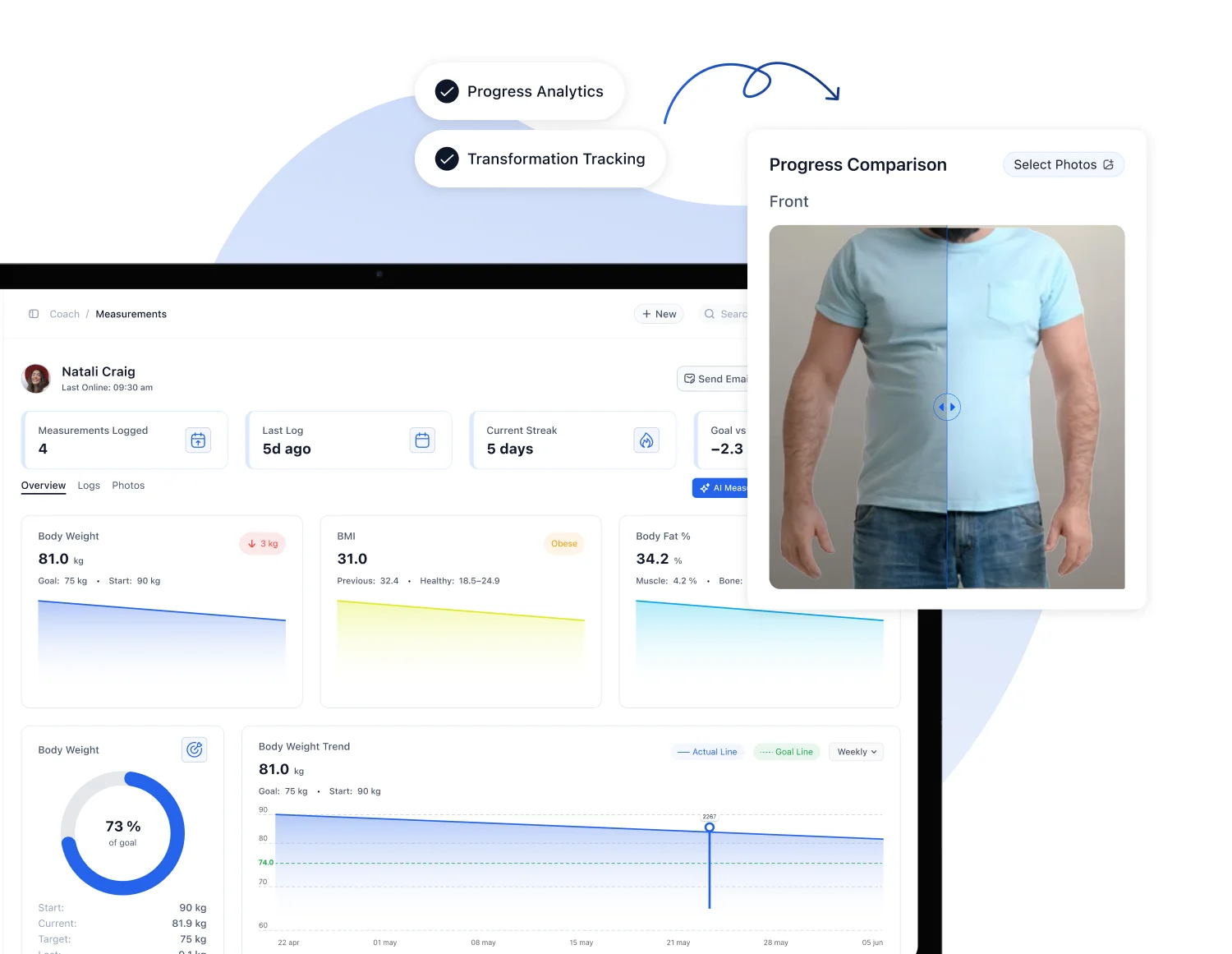
Fitness business analytics is the practice of turning bookings, attendance, payments, memberships and client progress into decisions about pricing, scheduling, staffing and retention. The core work is small: pick a short list of metrics, define each one, review them on a fixed rhythm, and change one thing at a time. This guide covers the metrics, the review routine, booking-data use, data quality and privacy, and a template to copy.
TL;DR
- Track a short scorecard: leads, conversion, recurring revenue, retention, attendance and payment collection.
- Retention is the metric most often overlooked by trainers, according to the Institute of Personal Trainers.
- Booking and attendance data show where schedules, staff and online PT slots do or do not match demand.
- Review weekly for operations, monthly for revenue and retention. Change one variable per cycle.
- Client data needs accuracy and privacy controls. Health-related data is sensitive.
What fitness business analytics means
Analytics in a fitness business is not a separate project. It is the routine of answering operating questions with records the business already creates.
Examples of questions:
- Which class times fill, and which stay half empty?
- How many leads become a first visit, and how many first visits become members?
- Which clients stopped booking three weeks ago?
- Which payments failed this month?
- Which coach has open slots, and which is overbooked?
Each question maps to a data type: bookings, attendance, lead sources, membership status, payments, check-ins and progress entries. Analytics starts when those records sit in one place and share the same client identity.
Who uses it, and how
| Business type | Main decisions | Typical data |
|---|---|---|
| Independent personal trainer | Session capacity, pricing, client churn | Appointments, cancellations, package use |
| Online coach | Check-in follow-up, program adherence | Forms, check-ins, measurements, messages |
| Studio | Class schedule, membership mix, staffing | Bookings, attendance, memberships, payments |
| Gym or club | Multi-location load, coach allocation, revenue by profit center | Visits, memberships, staff hours, non-dues revenue |
The scale changes. The method does not.
Metrics worth tracking
More metrics do not mean better decisions. A scorecard that nobody reads each week is worse than five numbers that drive action.
Retention
The Institute of Personal Trainers lists retention rate among the most overlooked core KPIs for trainers. It is also the cheapest lever: keeping a client costs less effort than finding a new one.
Definition to use:
- Retention rate = clients still active at the end of a period ÷ clients active at the start of that period.
- Churn = the inverse: clients lost ÷ clients at the start.
Write the definition down. Decide whether a paused membership counts as active. Keep that rule fixed.
Lead-to-member funnel
The BFS Network’s studio profitability report describes a practical scorecard built around leads, conversion from lead to first visit to member, recurring revenue and retention, alongside staffing, services, client visits and churn benchmarks. That structure works for small businesses too.
Track three steps:
- Leads in the period, by source.
- Leads who booked a first visit or intro call.
- First-visit clients who became paying members.
The drop between steps shows where to work. A weak step 2 points to follow-up speed or booking friction. A weak step 3 points to the offer, pricing or the first-session experience.
Recurring revenue and payment collection
Track monthly recurring revenue (MRR) as the sum of active membership and subscription charges. Separate it from one-off sales such as single sessions or product sales.

Also track failed payments. Australasian Leisure Management reported in June 2026 that ABC Fitness achieved collection rates of up to 98% using automated billing workflows that handle failed payment retries. That figure is one vendor’s reported result, not a benchmark for any other business. The takeaway for any operator: failed payments are recoverable revenue, and a retry and reminder process is worth defining.
Attendance and utilization
- Class fill rate = booked spots ÷ capacity.
- Show rate = attended ÷ booked.
- Coach utilization = booked hours ÷ available hours.
- Visits per member per week.
Low visit frequency often precedes cancellation. Treat it as an early signal, not a verdict.
Staff and revenue by source
For teams and clubs, add revenue per coach, sessions per coach and non-dues revenue. The Health & Fitness Association’s 2018 Profiles of Success report said its Industry Data Survey analyzed revenue, membership growth and retention, traffic, payroll, non-dues revenue and EBITDA, using 2016 and 2017 data from 115 club companies representing 12,289 facilities. The survey shows which categories larger operators compare across profit centers. The data is dated, so use it as a list of categories, not as targets.
A starter scorecard
| Metric | Formula | Review rhythm |
|---|---|---|
| Retention rate | Active at end ÷ active at start | Monthly |
| Lead-to-member conversion | New members ÷ leads | Monthly |
| MRR | Sum of recurring charges | Monthly |
| Failed payment rate | Failed charges ÷ attempted charges | Weekly |
| Class fill rate | Booked ÷ capacity | Weekly |
| Show rate | Attended ÷ booked | Weekly |
| Coach utilization | Booked hours ÷ available hours | Weekly |
| Check-in completion (online) | Submitted ÷ requested | Weekly |
Using booking and attendance data
Booking data is the most direct view of supply and demand. The calendar shows the supply: classes, small-group sessions, one-to-one appointments and online PT slots. Attendance shows what clients used.
Group classes
- Compare fill rate by day and time. Move or merge classes that stay under capacity.
- Compare show rate against booking rate. A high no-show rate suggests reminders or cancellation rules need work.
- Track waitlists. A persistent waitlist is a case for an added session.
Small-group and one-to-one sessions
- Check package use. Clients who buy ten sessions and use two need a follow-up.
- Look at cancellations by time slot and by coach.
- Count idle gaps between appointments. Gaps of 30 minutes across a day often add up to a lost session.
Online PT
- Pair session bookings with check-in completion and progress entries.
- Spot clients who book but skip check-ins, and clients who check in but never book calls.
- Use time zones in scheduling when clients live in other regions.
Teams coordinating coaches
When several coaches share a schedule, the question changes from “is my day full?” to “is the team’s capacity matched to demand?” Useful views:
- Open slots per coach per week.
- Which sessions each coach delivers, and how often.
- Which clients are assigned to which coach, so absences can be covered.
Calendar sync matters here. Coaches who already live in Google Calendar or Microsoft Outlook need personal commitments and client sessions to appear in the same view, otherwise double bookings appear. FITsociety lists Google Calendar and Outlook/Microsoft 365 integrations. Confirm the current sync behavior and plan availability on the FITsociety site before relying on a particular setup.
A review routine that produces action
Analytics fails when numbers are reviewed and nothing changes. Use a fixed rhythm.
Weekly: 20 minutes
- Open the calendar view. Note fill rates, no-shows and cancellations.
- List failed payments. Assign follow-up.
- List clients with no booking or check-in in the last two weeks.
- Pick one client contact action per at-risk client.
Monthly: 60 minutes
- Update the scorecard.
- Compare to the previous month, not to an industry figure.
- Identify the single weakest funnel step or retention drop.
- Choose one change. Write it down with a date and a metric that should move.
Quarterly
- Review pricing and package structure.
- Review staffing against utilization.
- Retire metrics nobody uses.
Change one thing at a time
If a studio changes class times, price and reminders in the same month, the result cannot be attributed. One change per cycle keeps cause and effect readable.
Worked example
The numbers below are illustrative, not results from any business.
A small studio starts a month with 80 active members and ends with 74 of those same members still active. Retention is 74 ÷ 80 = 92.5%. In the same month, 30 leads came in, 18 booked a first visit and 9 joined. Lead-to-first-visit is 60%. First-visit-to-member is 50%. Lead-to-member is 30%.

The weakest step is first visit to member. The studio changes one thing: a follow-up message within 24 hours after each first visit. Next month the same two ratios are compared.
Integration matters more than tool count
ABC Fitness recommended in 2026 that operators prioritize depth of integration between AI tools and core operational systems over the number of separate, disconnected point solutions. The same logic applies to analytics generally. When bookings, payments, forms and progress data live in separate tools, every review starts with exporting and matching spreadsheets. Matching errors then become decision errors.
What to look for in a setup:
- One client record linked to bookings, payments, forms and progress.
- Consistent status definitions: active, paused, cancelled.
- Export or API access for custom reports.
Where FITsociety fits
FITsociety is community-driven fitness software for personal trainers, online coaches, studios and gyms, developed with feedback from fitness professionals. It connects client and member administration, intake forms and check-ups, training and nutrition plans, progress tracking, bookings, communication, memberships and payments. Coaches work in a dashboard. Clients use a portal and mobile apps.
Relevant to analytics:
- Booking calendar for group classes, small-group sessions, one-to-one appointments and online PT.
- Google Calendar and Outlook/Microsoft 365 integrations.
- Memberships and payments in the same environment as coaching.
- Public API and MCP support for connected coaching workflows.
- CoachAI for drafting training plans, forms, recipes and news.
Published plans: Coach at €179 per month, Team at €289 per month and Club at €489 per month. Feature access by plan, API and MCP details and calendar sync behavior are listed on fitsociety.io. Check there for current plan contents before choosing.
Data quality and privacy
Analytics is only as good as the records behind it. Client data raises two separate concerns: accuracy and privacy.
Accuracy
The European Data Protection Board’s guidance on data protection by design says personal data must be accurate and kept up to date, with inaccurate data erased or rectified without delay. It warns that errors can lead to faulty health protocols or decisions based on a wrong profile. For a coach, that translates to practical checks:
- Update measurements and goals when they change.
- Remove duplicate client records.
- Correct wrong dates and statuses before reviewing retention.
- Keep injury and health notes current before programming from them.
Privacy and sensitive data
Under the EU’s GDPR, health data is defined broadly as information revealing past, current or future physical or mental health, including physiological or biomedical state, whatever its source. Body measurements, injury notes and nutrition logs can fall under that kind of definition. GDPR applies to businesses serving people in the EU. U.S. businesses should confirm which federal and state privacy rules apply to them with a qualified attorney.
The EDPB’s perspective on responsible analytics includes privacy by design and by default: transparency, user control, non-discrimination, human intervention and regular assessment of algorithmic fairness. Practical habits:
- Collect only the data a decision needs.
- Tell clients what is collected and why.
- Limit staff access by role.
- Use aggregated numbers in team meetings, not individual client details, unless the coach works with that client.
- Keep a person in the loop. Software output, including AI-drafted plans, is a draft. The professional reviews it and remains responsible for coaching decisions.
Template: monthly business review
Copy into a document or spreadsheet.
Period: ____
Scorecard
- Active clients or members, start / end: ____ / ____
- Retention rate: ____%
- Leads / first visits / new members: ____ / ____ / ____
- MRR: ____
- Failed payments, count and recovered: ____ / ____
- Average class fill rate: ____%
- Show rate: ____%
- Coach utilization, per coach: ____
Findings
- Strongest result: ____
- Weakest result: ____
- Clients at risk (no activity 14+ days): ____
Decision
- One change this month: ____
- Metric expected to move: ____
- Owner and date: ____
Data check
- Duplicates removed: yes / no
- Statuses corrected: yes / no
- Client data access reviewed: yes / no
Common mistakes
- Tracking everything and reviewing nothing.
- Changing metric definitions mid-year.
- Comparing a one-person practice to club-level benchmarks.
- Treating a vendor’s reported result as a norm.
- Ignoring small numbers: a drop from 10 clients to 8 is a 20% change.
- Acting on one month alone. Look for a trend over several periods.
FAQ
What is the first metric a solo trainer should track?
Retention. Count clients active at the start of a month and how many of them remain active at the end. Add attendance and failed payments next, since both are quick to review and tied directly to revenue.
How often should fitness business metrics be updated?
Operational numbers such as fill rate, no-shows and failed payments suit a weekly review. Revenue, retention and funnel conversion suit a monthly review. Pricing and staffing suit a quarterly review.
Do small businesses need analytics software?
Not at the start. A spreadsheet handles a scorecard for a small client base. Software becomes useful when bookings, payments and client records sit in separate places and manual matching takes time or introduces errors.
Can booking data help online coaches?
Yes. Pair call bookings with check-in completion and progress entries. Clients who stop booking or stop checking in are the ones to contact first.
Is client data from coaching sensitive?
Often, yes. Measurements, injuries and nutrition logs can reveal health information, which the GDPR defines broadly. Collect only what is needed, limit access, keep records accurate and confirm the rules that apply in your location with a qualified professional.
Sources
- KPIs for Personal Trainers: Definition & Formulas, Institute of Personal Trainers
- IHRSA Releases 2018 Profiles of Success, Health & Fitness Association
- BFS Strength Report: Profitability Benchmarks & Insights, BFS Network
- ABC Fitness outlines roadmap for embedded AI adoption, Australasian Leisure Management
- Guidelines 4/2019 on Article 25 Data Protection by Design and by Default, European Data Protection Board
- Regulation (EU) 2016/679 (GDPR), EUR-Lex