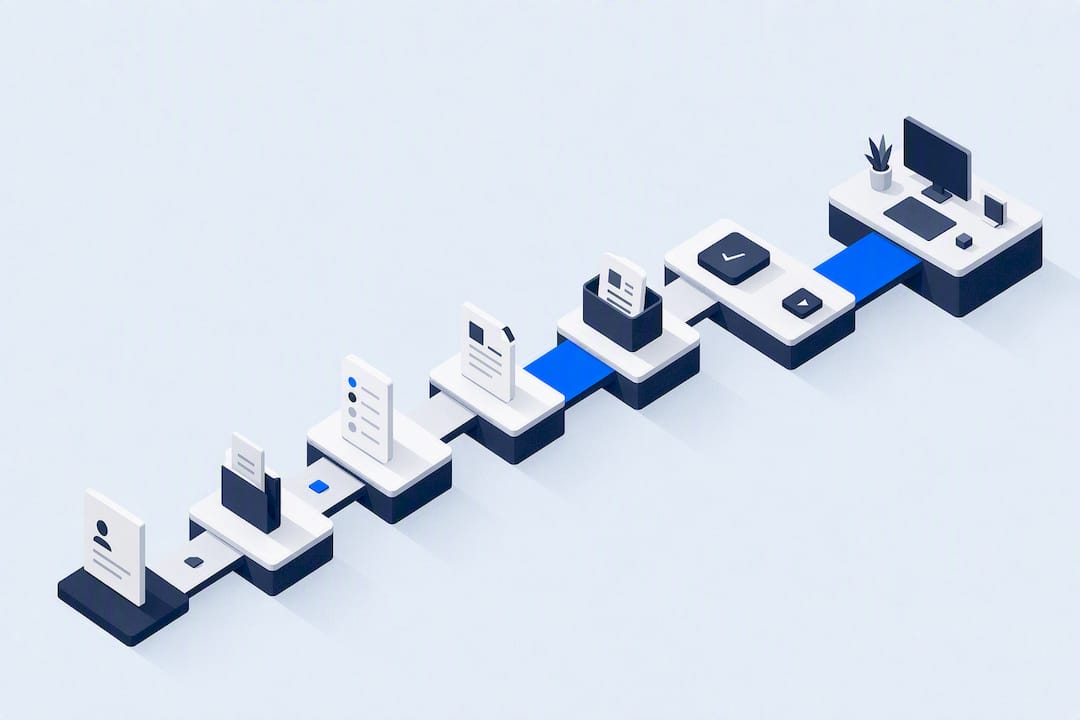
A fitness client onboarding process is the structured start of the coach–client relationship. It runs from signed agreement to the first progress review. It collects health and goal information, sets expectations, delivers a first session and schedules follow-up. Below: the steps, the screening questions, a trial-program flow, a reusable checklist and a way to run it in one system.
TL;DR
- Onboarding = agreement and payment, intake and health screening, welcome, first session, early check-ins, first-month review.
- Screening happens with every client. Fitness testing is selected per client, not applied to all.
- Trial programs need a defined end point and a stated next step from day one.
- Teams need one booking calendar, one intake record and a named owner for each step.
- A checklist template is included below. Adapt it to the business and local rules.
What a client onboarding process should achieve
Onboarding is not paperwork alone. ACE Fitness describes onboarding as the point where a trainer learns who the client is, what the client wants, why it matters and how the client prefers to work. The outcomes it names: shared goals, clear expectations, trust, better information for supporting the client and clarity about next steps.
The Institute of Personal Trainers defines the process as moving a client from signed agreement to informed, engaged participant. It covers documents, welcome communication, the first session and the first 30 days.
Practical goals for any coach:
- Reduce unknowns before the first session.
- Record health history and goals once, in one place.
- Make the first workout manageable.
- Give the client a clear picture of the next few weeks.
- Create a review point where progress is discussed.
ACE’s Kael Roberts links listening with empathy and understanding a client’s motivations to a trusting, respectful relationship and stronger engagement. That is the reason intake questions should ask why, not only what.
The three stages of onboarding
The same ACE article describes three parts. Applied to fitness coaching:
| Stage | Purpose | Coaching examples |
|---|---|---|
| Expectations and evaluation | Understand the client and goals | Intake form, goal conversation, health screening |
| Planning and agreement | Agree how coaching works | Service terms, session schedule, communication rules, payment setup |
| Confirmation | Make sure the client has what is needed to begin | Welcome message, logistics, first-session details, next actions |
The stages apply to a solo trainer, an online coach and a multi-location gym. Only the tools and the number of people involved change.
Fitness client onboarding: step by step
The Institute of Personal Trainers outlines a sequence that runs from agreement and payment through screening, welcome instructions, the first session, post-session follow-up, a week-one check-in and a first-month review. The steps below follow that order and add working detail.
1. Agreement and payment
Confirm the service, the price, the billing cycle, cancellation terms and session rules in writing. For recurring memberships, set up the payment method at the same time. A client who has paid but not yet received instructions is the point where doubt starts. Keep the gap short.
2. Intake form and goal information
Collect before the first session:
- Contact details and preferred communication channel.
- Primary goal and the reason behind it.
- Training history and current activity.
- Schedule, available days and equipment access.
- Injuries, conditions and medications relevant to exercise.
- Food preferences and restrictions, if nutrition is part of the service.
Short forms get completed. Split long questionnaires into a required core and optional detail the client can add later.
3. Health readiness screening
The Physical Activity Readiness Questionnaire (PAR-Q) is described in a WHO primary health care document as an internationally recognized tool for health professionals and fitness trainers. It assesses the safety and risks of exercise participation from health history and symptoms.
A positive answer on a screening form is a reason to refer the client to a physician or other qualified health professional before training. The decision stays with the coach and the client’s healthcare provider. Software only stores and routes the answers.
ACE states that preparticipation screening applies to each client. Fitness assessments are different: many clients do not need them, and they should match individual needs because they can demotivate some people.
4. Welcome instructions
Send a welcome message with:
- Time, place or video link for the first session.
- What to wear and bring.
- What the first session includes.
- How to reach the coach and expected reply times.
- Where to find the plan, forms and the schedule.
5. First session
Per the iPT description, the first session recaps goals, includes a baseline, delivers a manageable workout and outlines the next few weeks. Keep the baseline simple.
ACE suggests using the talk test or informal observation during initial low-intensity workouts. This assesses fitness without the intimidation that often comes with formal testing. Pete McCall of ACE argues that new clients should learn that exercise can be sustainable and non-punitive, and that a full-scale assessment too early can make activity seem intimidating or painful.

6. Post-session follow-up
Send a short message the same day. Include:
- One thing the client did well.
- What the next session covers.
- The booking for that session, already confirmed.
- A way to report soreness or questions.
7. Week-one check-in
Ask three questions: how did the sessions feel, what got in the way, what needs changing. Adjust the plan or the schedule based on answers. Early friction is mostly logistics: timing, travel, equipment, unclear instructions.
8. First-month review
The iPT sequence ends with a review of goals and progress and a preview of the next phase. Use measurements the client agreed to track. Confirm the goals still fit. Present the next phase and the booking for it.
Onboarding checklist template
Copy and adapt. Each row has an owner and a due point.
| Step | Owner | Due | Done |
|---|---|---|---|
| Service agreement signed | Coach | Before first session | ☐ |
| Payment method on file | Coach or admin | Before first session | ☐ |
| Intake form completed | Client | Before first session | ☐ |
| Health screening reviewed, referral if needed | Coach | Before first session | ☐ |
| Goals and reasons recorded | Coach | Before or at first session | ☐ |
| Welcome message sent | Coach or admin | After signup | ☐ |
| First session booked and confirmed | Admin | After signup | ☐ |
| Baseline noted (simple, client-appropriate) | Coach | First session | ☐ |
| Plan delivered to client portal or app | Coach | First session | ☐ |
| Follow-up message sent | Coach | Same day | ☐ |
| Week-one check-in done | Coach | End of week one | ☐ |
| Next sessions booked | Admin | End of week two | ☐ |
| First-month review held | Coach | End of month one | ☐ |
| Next phase and renewal discussed | Coach | First-month review | ☐ |
Welcome message template
Welcome, [name]. Your first session is [day, time, place or link]. Bring [items]. The session covers [short outline]. Your plan and forms are in [portal or app]. Questions before then: reply here. Replies come within [your reply window].
Fill the brackets with real details. Keep the reply window one the business can meet.
Intake question template
- What is the main thing you want from training?
- Why does it matter now?
- What have you tried before, and what happened?
- Which days and times work each week?
- Any injuries, conditions or medications a trainer should know about?
- How do you prefer to be contacted?
- What would make the first month a success for you?
Question 5 is part of screening, not a substitute for it. Use a recognized readiness questionnaire alongside it.
Onboarding a trial program client
Trials, intro weeks and first-session offers shorten the decision. They also shorten the time available to build trust. The onboarding steps stay the same. The timing compresses.
A workable trial flow:
- Reply fast. Answer inquiries promptly during business hours. Speed is the cheapest part of conversion.
- Screen first. Health screening applies to trial clients like any other.
- Book the trial with the full schedule visible. Offer the first session and the follow-up in the same booking step.
- Define the trial. State length, number of sessions, what is included and what happens afterward.
- Run a short first session. Manageable workout, simple baseline, outline of the next steps.
- Check in mid-trial. One message asking what is working.
- Hold a closing conversation. Review what the client did, restate goals and present the next step with a price and a start date.
A time-bound next step helps. A client who leaves the trial without a booked follow-up has to decide again from scratch.
Do not hide the conversion step. Say at the start that the trial ends with a conversation about continuing. That is honest, and it removes awkwardness at the end.
Coordinating onboarding across formats
One-to-one clients, small groups, classes and online clients need the same core record but different logistics.
| Format | Extra onboarding needs | Common failure |
|---|---|---|
| One-to-one | Goal depth, schedule fit, session location | Informal scheduling by message |
| Small group | Level match, group rules, capacity | New member joins without intake |
| Group classes | Class rules, booking and cancellation policy, equipment | No screening because “it’s just a class” |
| Online PT | Tech check, video setup, equipment at home, check-in cadence | Plan delivered with no review date |
For teams, add three rules:
- One intake record per client. Any coach who sees the client sees the same information.
- A named owner for every step. “The team” is not an owner.
- One calendar. Bookings, availability and sessions in one place prevent double-booking and missed first sessions.
Coaches who also use Google Calendar or Microsoft Outlook often want bookings to appear where they already look. FITsociety lists Google Calendar and Outlook/Microsoft 365 integrations. Verify sync behavior and plan availability on the official calendar feature page before relying on it in a workflow.
Check-ins and reviews that improve onboarding
Onboarding does not end at the first session. Check-ins show where the process works and where it loses people.
FutureLearn’s client orientation guidance lists information collection, health pre-screening, appropriate fitness testing, SMART goals, program prescription and reassessment as core components. It recommends a general review every 3 months and a full program review every 6 months. Those are useful anchors after the first-month review.
To improve the process itself, track simple items:
- Time from inquiry to first session.
- Share of clients with a complete intake before session one.
- Share attending the week-one check-in.
- Share booking sessions beyond the first month.
- Reasons clients give for leaving in the first 90 days.
Review these monthly. One change at a time. A single fix, such as shortening the intake form, shows its effect more clearly than five.
Check-in prompts that return useful answers:
- “What felt harder than expected?”
- “What got in the way this week?”
- “What would you change about the schedule?”
- “What do you want to see in the next four weeks?”
Running the process in one system
A spreadsheet, a form tool, a calendar, a payment processor and a messaging app can run onboarding. Each handoff between them is a place where a client gets lost. All-in-one coaching software reduces handoffs.
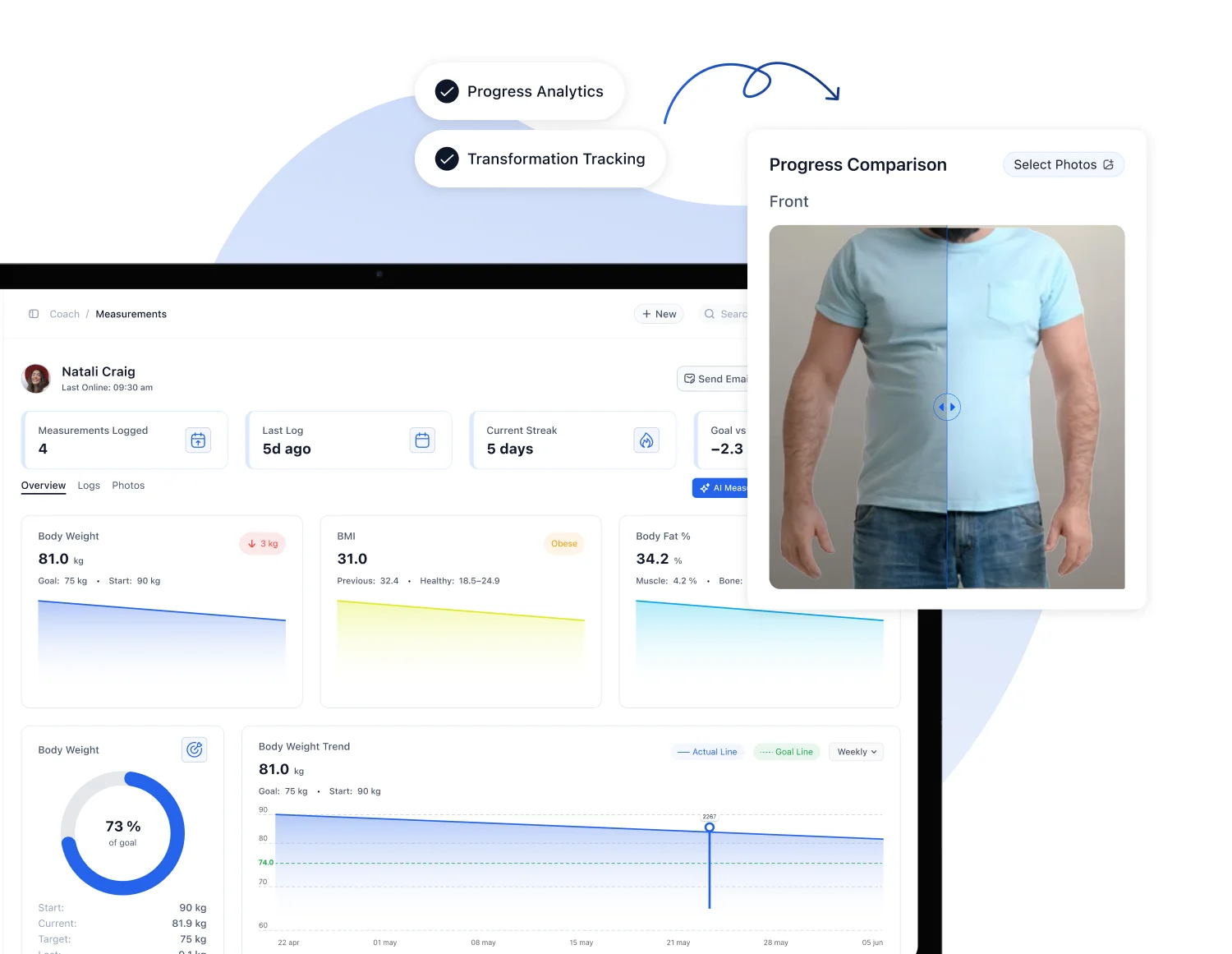
FITsociety is community-driven fitness software, developed with feedback from fitness professionals. It connects client administration, intake forms and check-ups, training and nutrition plans, progress tracking, bookings, communication, memberships and payments. Coaches work in a dashboard. Clients use a portal and mobile apps. CoachAI supports drafting tasks such as training plans, forms, recipes and news. Coaches review and decide what reaches clients.
Mapped to the steps above:
| Onboarding step | Capability |
|---|---|
| Agreement and payment | Memberships and payments |
| Intake and screening | Intake forms and check-ups |
| Welcome and follow-up | Communication |
| First session and classes | Booking calendar for group classes, small groups, one-to-one and online PT |
| Plan delivery | Training and nutrition plans |
| Reviews | Progress tracking |
The public API and MCP support exist for connected coaching workflows. Check endpoints, supported actions, permissions and plan access in the official documentation before building on them.
Plans are listed at €179 per month for Coach, €289 per month for Team and €489 per month for Club, as published on the site when this was written. Check the FITsociety site for current plan details and the trial.

FITsociety provides the software. Coaches deliver the coaching and remain responsible for their decisions, including screening outcomes and referrals.
Common onboarding mistakes
- Forms too long. Cut to what the first month needs.
- Testing everyone. Select assessments by client need.
- No next booking. Every session ends with the next one scheduled.
- Silent first week. Contact the client before they have to contact the coach.
- Unwritten terms. Cancellation and payment rules belong in the agreement, not in memory.
- No review date. A plan without a review date drifts.
FAQ
What are the steps in client onboarding?
Agreement and payment, intake and health screening, welcome instructions, the first session, post-session follow-up, a week-one check-in and a first-month review. The order can shift, but screening comes before training. Each step needs an owner and a due point.
What are the three stages of customer onboarding?
Expectations and evaluation, planning and agreement, and confirmation. In coaching: understand the client and goals, agree how coaching works, then confirm logistics and next actions before the first session.
How long should fitness client onboarding take?
The core process is commonly framed as the first 30 days, from signed agreement to a first-month review. Intake and screening should be finished before the first session. Reviews continue afterward, for example every 3 months for a general review and every 6 months for a full program review.
Do all clients need fitness testing during onboarding?
No. Screening applies to each client, while fitness assessments are chosen by individual need. Informal methods such as the talk test during a low-intensity first workout can show fitness levels without formal testing.
How should a trial program be onboarded?
Use the same intake and screening as a full client. State the trial length and what follows at the start. Check in mid-trial and hold a closing conversation with a priced next step and a booked start date.
Sources
- The Importance of Onboarding New Clients, ACE Fitness
- Client Onboarding for Personal Trainers: Definition, Institute of Personal Trainers
- Primary health care document on the PAR-Q, WHO
- Client-centered assessments, ACE Certified, September 2021
- ACE Integrated Fitness Training Model, ACE Certified Program Design Special Issue 2017
- Client Onboarding and Orientation Screening Process, FutureLearn