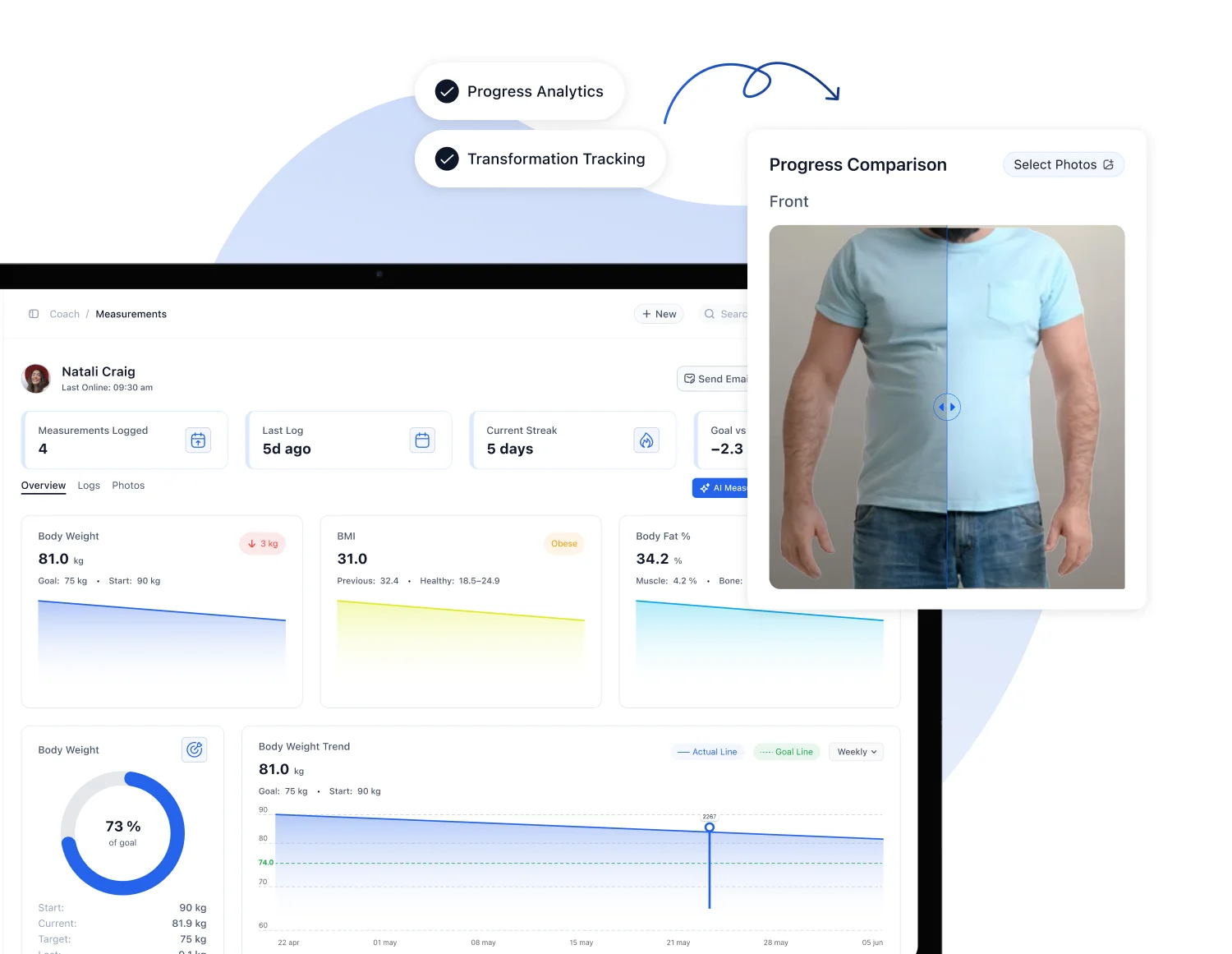
Client adherence tracking is the routine of recording whether a client does what the plan asks: sessions attended, workouts completed, meals logged, check-ins submitted. For coaches, the useful version tracks a few behaviors consistently, reads them in context, and triggers a conversation when the pattern changes.
The top search results for this term cover medication and patient adherence. This guide covers the coaching side: personal training, online coaching and studio programs.
TL;DR
- Adherence in coaching means behavior that matches the client’s own goals and values, not obedience to instructions.
- Track a small set: sessions, workouts, nutrition logs, habits, check-ins. More tasks can lower adherence.
- Combine automatic records (bookings, completed workouts) with client self-report.
- Numbers need a conversation. Data alone does not explain why a client drifted.
- Define the follow-up rule in advance: what counts as a miss, who reaches out, and when.
What client adherence means in coaching
Adherence is often treated as compliance. The American Council on Exercise frames it differently: adherence is the strength of the link between a client’s attitudes and behavior, meaning whether what clients do matches what they think and value.
Practical consequences:
- A missed session is information, not a verdict.
- A plan the client cannot sustain is a plan design problem as often as a client problem.
- Tracking serves the conversation between coach and client.
What to track
The right metrics depend on the service. Pick the few that connect to the client’s goal and track them the same way every week.
| Area | What to record | Source | Typical review rhythm |
|---|---|---|---|
| Sessions | Booked, attended, canceled, no-show | Booking calendar | Weekly |
| Training | Workouts completed vs. planned, logged loads | Client app or portal | Weekly |
| Nutrition | Days logged, plan vs. actual, notes | Client log | Weekly |
| Habits | Daily habit completion (sleep, steps, water) | Habit log | Weekly |
| Check-ins | Submitted on time, late, missed | Check-in form | Per check-in cycle |
| Body data | Weight trend, measurements, optional photos | Client entry | Every 1 to 4 weeks |
| Subjective | Energy, stress, sleep, soreness, mood | Check-in form | Per check-in cycle |
| Communication | Replies, message frequency | Chat | Ongoing |
Two kinds of adherence
- Attendance adherence: the client showed up, logged in, submitted the form.
- Plan adherence: the client performed the prescribed work and nutrition at the prescribed level.
Attendance is easy to count. Plan adherence takes logs and judgment. Track both, and do not mistake the first for the second.
How researchers measure it
A 2022 scoping review in JMIR on mobile physical activity programs found 31 different adherence-measurement methods grouped into four dimensions: length, breadth, depth and interaction. Translated to coaching:
- Length: how long the client stays active in the program.
- Breadth: how many parts of the program they use (training, nutrition, habits, check-ins).
- Depth: how fully they complete each part.
- Interaction: how often they engage with the coach and the app.
This gives a simple checklist for a client dashboard: how long, how many features, how fully, how often.
Automatic records and self-report
Each data source has weaknesses. The same review notes that automatic recording and self-report each have limitations, and suggests combining them.
- Automatic: bookings, check-in timestamps, completed-workout flags. Objective, but they show activity, not effort or quality.
- Self-report: food logs, mood, perceived effort. Richer, but dependent on memory and honesty.
Self-monitoring has real friction. A 2024 BMC Digital Health study found barriers including forgetfulness, burdensome processes and inaccurate data, with diet tracking especially hard because food databases can be inaccurate and entry is slow.
Implications for coaches:
- Ask for less, more consistently.
- Use simple nutrition targets or photo-free logging for clients who struggle with detailed entry.
- Treat gaps in logs as a signal to simplify, not only to nag.
The JMIR review also associated feedback, reminders, interpersonal contact, tailored interventions, automated data input and ease of use with higher adherence, and multiple tasks with lower adherence. Evidence on age, education and weight was inconsistent, so no client should be pre-labeled by demographics.
Setting up a tracking system
A workable system has five parts.
- Define adherence per client. Write down two or three behaviors that matter for this client’s goal. A client training for a first 10K and a client managing a busy travel schedule need different definitions.
- Set thresholds. Example: below 60% of planned workouts for two consecutive weeks triggers outreach. The numbers are the coach’s call; the point is to decide before the problem appears.
- Standardize the check-in. Same questions, same day, same format.
- Automate reminders. Reminders for check-ins, sessions and logs reduce the manual chasing.
- Schedule the review. A weekly block for scanning all clients, plus deeper monthly reviews.
Check-in content
A regular check-in can ask about:
- Sessions completed vs. plan
- Nutrition vs. plan
- Weight trend and measurements
- Energy, stress, sleep, soreness, mood
- Next week’s goals
- Expected obstacles
Keep it short. Every added field is another task, and multiple tasks are linked to lower adherence.
Coordinating bookings and coaching
For studios and teams, adherence data is split across places: the calendar holds attendance, the app holds workouts, chat holds context. When several coaches serve one client, no one sees the full picture unless these records sit together.
Good practice:
- One client record visible to every coach assigned to that client.
- Group classes, small-group sessions, one-to-one appointments and online PT tracked in the same calendar.
- Cancellations and no-shows reviewed next to workout and check-in data, not in isolation.
Reading the data fairly
Numbers invite quick conclusions. Research suggests caution.
A peer-reviewed study on personal health data in coaching found data are useful when specific, contextualized and meaningful to the client’s goals, while numbers alone are insufficient. Reviewing the data together with the client helps the coach interpret the client’s experience.
A study of elite athletes found that insufficient feedback and opaque or disproportionate decisions based on monitoring data undermined adherence and encouraged dishonest reporting. The lesson applies at any level:
- Tell clients what is tracked and why.
- Give feedback every time data is submitted.
- Do not punish low numbers. Clients who fear consequences may stop reporting accurately.
Questions before judging a dip
- Did the schedule change (travel, work, illness)?
- Was the plan too large for the week?
- Did the client understand the task?
- Is the tracking method itself the obstacle?
- Did the client receive feedback the last time they reported?
Following up on misses
Patterns matter more than single events. In a study of a chronic-disease eHealth platform, a model predicted dropouts with 89% precision, and two weeks of inactivity was among the key predictors. That study involved patients, not gym clients, so treat it as a reason to watch inactivity streaks, not as a coaching benchmark.

Communication also matters. A JMIR study of remote physical therapy reported that each therapist message was associated with an 11% increase in weekly workouts. It is a setting different from fitness coaching, and the association is not a guarantee, but it supports prompt, direct messages.
A simple follow-up ladder
| Signal | Response |
|---|---|
| One missed workout or log | Nothing, or a light reminder |
| Missed check-in | Short message the same day: ask what got in the way |
| Two weeks of low activity | Call or video chat; review the plan and reduce load if needed |
| No contact beyond two weeks | Personal outreach from the coach; offer a restart plan |
| Repeated pattern over a month | Reassess goals, schedule and service level together |
Message tone:
- Ask, do not accuse.
- Offer a smaller next step.
- Confirm the next date.
Remote support tools can help with home exercise too. A small pilot study of patients with musculoskeletal conditions found a remote-support app improved home-exercise adherence compared with paper handouts over four weeks. Small and clinical, so it is directional evidence only.
Privacy and consent
Adherence records are personal data, and body measurements, photos and mood notes can be sensitive. Before collecting:
- Tell clients what is collected, why and how it is stored.
- State whether any third party receives the data.
- Collect only what the plan needs.
- Make optional items (such as progress photos) genuinely optional.
The international privacy standard ISO/IEC 29184:2020 sets out that privacy notices should be accessible, timely and clear about purpose, collection method and third-party transfers. Legal duties differ by country and state, so confirm requirements for your location and business type with a qualified professional.
Weekly adherence review template
Copy into a document or use as a recurring task. One row per client.
| Client | Sessions attended / planned | Workouts done / planned | Nutrition days logged | Check-in submitted | Energy / stress / sleep | Flag | Next action |
|---|---|---|---|---|---|---|---|
| / | / | /7 | Yes / Late / No |
Review checklist:
- [ ] Bookings and cancellations checked
- [ ] Workout completion compared with plan
- [ ] Nutrition and habit logs scanned
- [ ] Check-in answers read, not only counted
- [ ] Feedback sent to every client who submitted data
- [ ] Clients crossing a threshold contacted
- [ ] Plans adjusted where the load was unrealistic
- [ ] Notes added for the next review
Monthly additions:
- [ ] Trend in weight, measurements and strength
- [ ] Goal still correct?
- [ ] Client’s own view of what is working
- [ ] Tracking burden still reasonable?
Tracking in FITsociety
FITsociety is community-driven fitness software, developed with feedback from fitness professionals. It brings client administration, intake forms and check-ups, training and nutrition plans, progress tracking, daily habit logging, bookings, chat, memberships and payments into one environment. Coaches work in a dashboard; clients use a portal and mobile apps. That keeps attendance, plan data and communication in the same place.
Published plans, as listed on the site:
- Coach: €179 per month
- Team: €289 per month
- Club: €489 per month
Details on features and plans are on fitsociety.io.
FAQ
What is client adherence tracking?
It is the recording of whether clients follow their plan: sessions attended, workouts done, nutrition logged, check-ins submitted. The goal is to spot patterns early and respond with coaching, not to police clients.
Which adherence metrics matter most?
That depends on the client’s goal, but a core set covers attendance, workout completion, nutrition or habit logs and check-in submission. Keep the list short, because more tasks can lower adherence.
How often should coaches review adherence?
A weekly scan of all clients works for most programs, with a deeper monthly review of trends and goals. Review sooner when a client misses a check-in or goes quiet.
What should a coach do when a client stops logging?
Reach out promptly and ask what got in the way. Simplify the tracking, reduce the plan if it is too large, and agree a small next step. Avoid reacting to low numbers with criticism.
Sources
- ACE: Stop chasing motivation, a behavior-first way to build exercise adherence
- Measurement of Adherence to mHealth Physical Activity Interventions (JMIR, 2022)
- Decoding heterogeneity in data-driven self-monitoring (BMC Digital Health, 2024)
- The Influence of Personal Health Data on the Health Coaching Process
- Training-Monitoring Engagement: An Evidence-Based Approach
- Predicting Dropouts From an Electronic Health Platform
- JMIR Rehabilitation (2022): coach messages and weekly workouts
- Development and Feasibility Testing of a Remote Support App
- ISO/IEC 29184:2020 sample