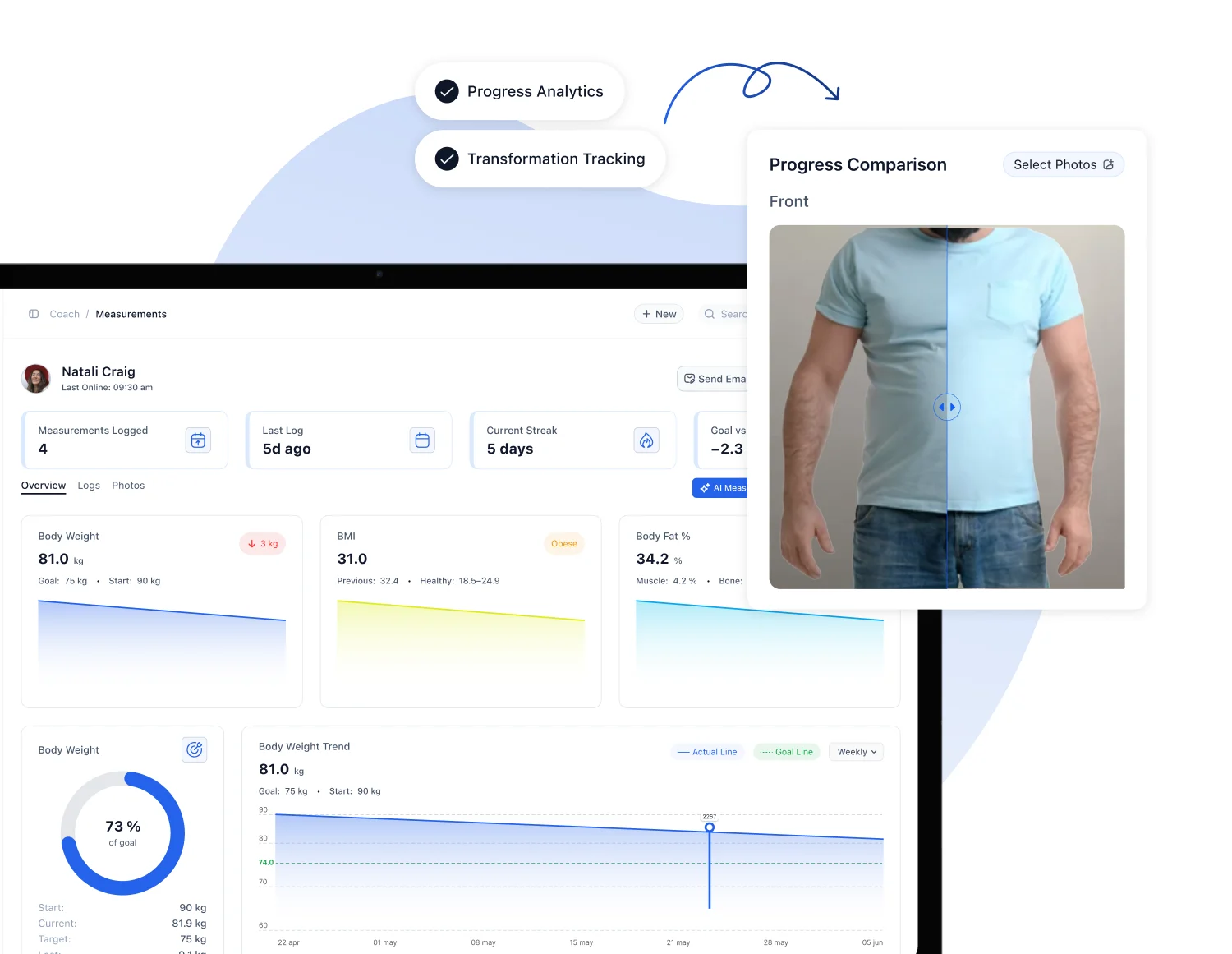
The tool mix with the strongest evidence behind it combines self-monitoring, defined goals, automated reminders, and regular coach contact, especially phone or video check-ins early in a program. Systematic reviews and meta-analyses report modest, consistent short-term gains from this combination. The checklist below turns that evidence into software settings and coaching routines. Platforms such as FITsociety bundle these workflows into one dashboard.
TL;DR:
- Early high-touch contact, including weekly check-ins and automated prompts, supports short-term adherence but long-term effects are less certain.
- Setting notification thresholds for low log activity and using targeted, simple self-monitoring methods improves engagement and reduces drop-off rates.
- Coaches should deliver onboarding, set specific goals, monitor logs proactively, and tailor logging methods to client needs for maximum adherence.
- Platforms like FITsociety facilitate integrated workflows for scheduling, logging, messaging, and data visibility, simplifying adherence management.
Evidence-backed features that improve client adherence
Self-monitoring alone produces results. Self-monitoring plus other components produces more. A meta-analysis of physical activity interventions found that combining self-monitoring with reminders, feedback, or goal setting outperformed self-monitoring alone.
A meta-analysis found a mean postintervention increase of about 926 steps per day when self-monitoring was combined with other intervention components. That gain reflects group averages across trials, not a guarantee for any one client.

Two factors moderated the size of the effect in that review: set goals and human counselling delivered by phone or video. Both increased the benefit compared with self-monitoring on its own.
These findings translate into concrete feature requirements:
- Activity and device sync, so logged steps or workouts reach the coach without manual entry.
- Dietary logging with low friction, since diet logs carry more drop-off than activity logs.
- Automated reminders tied to missed check-ins, not just fixed schedules.
- Coach-side access to client logs, not just client-facing dashboards.
- Two-way messaging for quick feedback loops.
- Goal templates that set specific, trackable targets rather than vague intentions.
- Check-in scheduling that supports recurring cadences.
A systematic review of digital adjuncts to home exercise programs found that 7 of 10 trials reported short-term adherence gains. Longer-term effects were mixed, and evidence quality was rated low to moderate. Usability friction, meaning clunky logging or confusing apps, tends to erode the gains over time even when the early results look strong.
Coach workflows that turn features into adherence
Features set the ceiling. Workflow determines whether a client reaches it. A reproducible sequence works across most client types.
- Onboard with intake forms and baseline measures. Capture starting activity levels, diet patterns, and goals before setting targets.
- Set specific, target-level goals. Activity, diet, and weight each need their own goal, not one combined target.
- Run a high-touch early cadence. Weekly or biweekly remote check-ins for the first 4 to 6 weeks, paired with automated reminders, match the moderators identified in adherence research.
- Monitor logs proactively. Review client data on a schedule rather than waiting for a client to report a problem.
- Set notification thresholds for lapses. A drop in logging frequency, not just a missed session, is often the earlier warning sign.
- Apply structured problem-solving when patterns show lapses. Lifestyle coaching research identifies repeated problem-solving practice as a dominant approach for sustaining behavior change.
- Add group or peer accountability where it fits. Group classes or small-group sessions can supplement one-to-one coaching without replacing it.
Pro Tip: Set notification thresholds on relative drops in logging frequency, not just absolute misses. A client who goes from daily logs to every third day is showing an earlier signal than one who skips a single session.
Coaches running this sequence need calendar tools that support both individual appointments and group bookings. FITsociety’s calendar features cover scheduling for one-to-one online PT sessions and group classes, with Google Calendar and Outlook and Microsoft 365 integrations available for coaches syncing across personal and business calendars. Coaches building connected workflows with external tools can also use a public API offered by some platforms.
Checklist for configuring software to maximize adherence
Configuration decisions made at setup determine how much manual follow-up a coach does later.
- Set default goal templates and reminder cadences before adding new clients, not after.
- Prefill intake templates so baseline data is captured consistently across the roster.
- Enable coach-side visibility into logs rather than relying on clients to report progress manually.
- Set notification thresholds for low logging frequency and missed sessions.
- Prescribe target-specific self-monitoring: a device or app for activity, a lightweight food log for diet, and a weekly weigh-in rather than daily weigh-ins.
- Offer alternate logging formats, such as photo-based food logs or simple checklists, for clients who find app-based logging a barrier.
- Schedule a usability check-in with new clients around week 2 to catch friction early.
- Define a measurement window and pilot the workflow with a small cohort before rolling it out to the full client list.
| Checklist item | Why it matters |
|---|---|
| Default goal templates | Removes setup delay and keeps goals specific |
| Coach visibility into logs | Enables proactive outreach instead of reactive chasing |
| Notification thresholds | Flags declining engagement before it becomes a missed session |
| Target-specific self-monitoring | Matches logging effort to what research shows clients sustain |
| Alternate logging formats | Reduces drop-off from low-tech or time-pressed clients |
| Pilot cohort | Confirms the cadence works before a full rollout |
Coaches moving from spreadsheets or multiple apps to a single platform often start with this checklist as the rollout plan. A practical implementation guide walks through the sequencing in more detail.
Measuring adherence: what to track and how to read the signals
Adherence is not one number. It is a small set of metrics that, read together, show whether a client is on track or drifting.
| Metric | What it signals |
|---|---|
| Percent of days logged | Engagement with self-monitoring |
| Session attendance rate | Follow-through on scheduled coaching |
| Steps per day change | Activity-level progress |
| Plan completion rate | Whether prescribed workouts or meals are being done as written |
| Message or response latency | Client engagement with coach communication |
The meta-analysis cited earlier reported a mean postintervention increase of about 926 steps per day as a realistic benchmark for combined interventions. Expect that kind of gain to show up more reliably in the short term than over many months.
Common signal patterns worth watching:
- A decline in logging frequency often precedes a drop in session attendance, not the reverse.
- A widening gap between planned and completed sessions usually signals a scheduling or motivation issue, not a fitness one.
- Slower message response times from a client can be an early sign of disengagement before a missed check-in confirms it.
Report these metrics back to clients in plain terms during check-ins, and use the pattern, not a single data point, to decide when to adjust the cadence or reach out directly.
Integration of client adherence tools with electronic health records and other healthcare systems
Most personal trainers and online coaches operate outside clinical settings, so adherence software for this audience generally does not connect to electronic health records. EHR integration is more relevant to clinical and rehabilitation contexts, where a physical therapist or physician needs adherence data inside a patient’s medical record.
For independent coaches and fitness studios, the more relevant integration question is whether the coaching platform connects to the tools already in use: calendar systems, payment processors, and communication channels. A public API, where available, lets a coach or studio build connections to other systems as needed, though the specific endpoints and supported actions vary by platform and should be confirmed on the provider’s own documentation before planning an integration.
Coaches working alongside a healthcare provider, such as supporting a client’s physical therapy plan, should treat any data-sharing arrangement as a separate conversation with that provider about what they need and how it will be transmitted. Fitness coaching software is not a substitute for a clinical record system, and presenting it as one risks overstating what the software does.
Privacy and data security considerations for client adherence tools
Client adherence data includes activity logs, dietary entries, body measurements, and messages between coach and client. That makes it sensitive information worth handling deliberately.
Coaches evaluating software should check a few baseline points before storing client data in any platform:
- Where client data is stored and whether the provider states its security practices publicly.
- Who within a coaching business can view client logs, and whether permission levels can be restricted by role.
- How client data is handled if a client cancels or a coach leaves a team.
- Whether the platform supports role-based access for teams with multiple coaches.
Platforms built for teams, rather than single coaches, generally offer more granular permission controls, since studio managers need to limit which coaches see which clients’ data. Coaches should confirm permission settings and data-handling practices directly on a provider’s official documentation rather than assuming default settings fit their business.
Clients also respond to transparency. Telling a client plainly what data is collected and who on the coaching team can see it tends to reduce hesitation about logging consistently, since reluctance to log often comes from uncertainty about who is watching.
User engagement strategies beyond reminders
Reminders get a client to log. They do not always keep a client motivated to keep logging for months. A few other mechanisms support longer engagement.
Progress visualization, such as a dashboard showing trend lines for weight, steps, or workout completion over time, gives clients a reason to check in beyond the reminder itself. Seeing a trend is more motivating than seeing a single data point.
Group and peer accountability structures add a social layer that one-to-one coaching does not fully replace. Group classes or small-group training sessions, where clients see each other show up consistently, can reinforce attendance in ways that individual reminders cannot. This works alongside, not instead of, one-to-one coaching.

Milestone recognition, such as marking a streak of consistent logging or a completed training block, gives clients a visible marker of progress distinct from the end goal. This does not require elaborate gamification mechanics to be useful. A simple, visible count of consecutive days logged often does the job.
Supportive accountability research points to a simpler mechanism underneath all of these tactics: clients adhere more when they believe someone is monitoring their progress and genuinely cares about the outcome. Features that make that monitoring visible to the client, such as a coach comment on a logged meal or a quick message after a missed session, reinforce that belief more directly than a badge or streak counter does.
Evaluation methods for effectiveness and usability of adherence tools
Choosing adherence software by feature list alone misses a key variable: whether clients will actually use it. Evaluation works best across two separate questions. Does it improve adherence, and is it usable enough for clients to stick with.
Effectiveness is best judged with a small pilot rather than a permanent commitment to one tool. Onboard a limited cohort, run a defined cadence for several weeks, and track the metrics outlined earlier: percent of days logged, attendance rate, and plan completion rate. Comparing the pilot cohort’s numbers against a prior period gives a coach a direct read on whether the new workflow is moving the needle.
Usability is harder to measure with a single number, but a few practical checks work well. Ask new clients directly, around the second week, whether logging feels like a chore. Watch for drop-off in the first 7 to 10 days, since early disengagement often predicts later disengagement. Check whether clients who skip logging are also the ones using alternate formats like photo logs, which can indicate the primary logging method is the barrier.
A systematic review of digital home exercise adjuncts found that short-term effects were more consistent than long-term ones, with usability cited as a limiting factor in sustained engagement. That is a reason to re-evaluate a tool’s fit every few months rather than assuming an initial pilot result holds indefinitely.
Customization and personalization of adherence tools for different client populations
Adherence research shows that self-monitoring behaves differently depending on what is being tracked. A study on digital self-monitoring targets found that activity logging sustained higher adherence than dietary or weight logging, and that higher adherence to each specific target predicted better outcomes. That is a strong argument for customizing the self-monitoring method by target rather than using one generic logging flow for everything.
Client populations also differ in what reduces friction. Beginners generally need simpler goal structures and more frequent, lower-stakes check-ins. Clients returning after an injury or working with a physical therapist need goal templates built around rehabilitation milestones rather than performance targets. Busy clients with limited time for logging benefit more from passive data sync, such as device-connected activity tracking, than from manual diet entry.
Nutrition logging is a clear case where personalization pays off. A nutrition tracking workflow built around quick meal and macro logging reduces the friction that causes diet logs to lapse faster than activity logs. Coaches working with populations who find food logging tedious often get better results prescribing a lighter version, such as logging only protein intake or meal timing, rather than dropping dietary monitoring altogether.
How FITsociety supports these adherence workflows and next steps
FITsociety is community-driven fitness software built with input from personal trainers, online coaches, and fitness studios, with ongoing improvements shaped by feedback from that community. It connects the pieces this checklist depends on into one coach dashboard and client portal, rather than requiring a coach to stitch together separate tools for scheduling, logging, and messaging.
- Calendar and booking tools cover group classes, small-group sessions, one-to-one appointments, and online PT, with Google Calendar and Outlook and Microsoft 365 sync available.
- Training and nutrition plan tools, including CoachAI support for drafting plans and recipes, give coaches templates to prefill for new clients.
- Check-ins and a coach-facing dashboard provide visibility into client logs without manual chasing.
- A public API and MCP support are available for coaches building connected workflows with other systems.
A practical way to test this fit: onboard 10 clients, run the 6 to 8 week cadence outlined above, and track percent of days logged and step-count change against the pilot’s starting point. Visit FITsociety’s coaching page to review plan details and request a demo before committing a full client roster to a new workflow.
FAQ
What is the most effective combination of adherence tools?
Research points to self-monitoring combined with set goals, automated reminders, and regular human contact, particularly phone or video check-ins. A meta-analysis found this combination produced a mean postintervention increase of about 926 steps per day compared with self-monitoring alone.
How often should coaches check in with clients for best adherence?
Weekly or biweekly check-ins during the first 4 to 6 weeks of a program align with the cadence linked to stronger short-term adherence gains in intervention research. Coaches can taper the frequency once logging and attendance patterns stabilize.
Do digital adherence tools work better short-term or long-term?
Short-term improvements, generally within the first 6 weeks, are more consistently reported than long-term ones. A systematic review of digital exercise adjuncts found 7 of 10 trials showed short-term gains, while longer-term effects were mixed.
Which self-monitoring target is easiest for clients to stick with?
Activity logging tends to show higher and more stable adherence than dietary or weight logging, according to research comparing self-monitoring targets. Coaches can use this to prioritize activity tracking first and introduce diet logging with lighter-touch formats.
Can coaches use one platform to manage bookings, check-ins, and client logs together?
Yes. Platforms built for fitness coaching, such as FITsociety, combine scheduling, plan delivery, and check-ins in one dashboard so coaches do not need separate tools for each workflow. Specific features and plan availability should be confirmed on the provider’s official pages.
Sources
- Do physical activity interventions combining self-monitoring with other components provide an additional benefit compared with self-monitoring alone? A systematic review and meta-analysis
- Do digital interventions increase adherence to home exercise rehabilitation? A systematic review of randomised controlled trials