
A fitness liability waiver documents a client’s acceptance of exercise risks and works as a strong defense against ordinary-negligence claims, but it is not absolute protection. Require a signed, dated waiver before first access, pair it with insurance coverage, and have a local attorney review the language. A ready-to-use template and execution checklist follow below.
TL;DR:
- Signed waivers must name specific activities and risks to be enforceable, avoiding vague phrases like “all risks of exercise.”
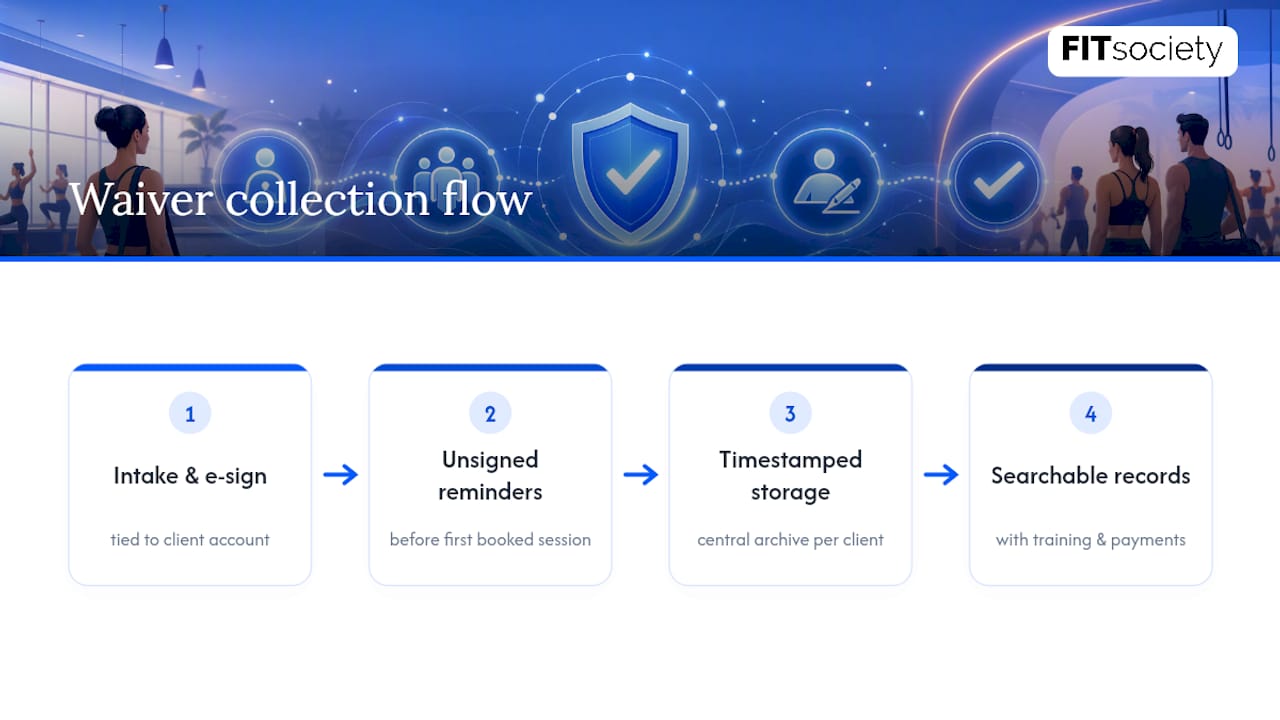
- Collect waivers before the client engages in activity, using electronic signatures with timestamps stored centrally and linked to client records.
- Waivers do not cover gross negligence or injuries to minors unless local law explicitly enforces parental signatures, and timing is critical for validity.
- Pair waivers with safety records, maintenance logs, and health screenings to strengthen legal defenses against challenges.
- Use modular, activity-specific addenda to address risks unique to high-risk classes, ensuring clear and enforceable documentation.
What Is a Fitness Liability Waiver, and Who Needs One?
A fitness liability waiver is a contract in which a client voluntarily acknowledges the inherent risks of exercise and agrees to release the trainer or facility from liability for injuries tied to ordinary negligence. It’s not a permission slip. It’s a legal record showing the client understood what could go wrong before they started.
Any business where physical activity creates injury risk needs one. That includes:
- Gyms and health clubs with open-access equipment floors
- Boutique studios running group classes (cycling, HIIT, barre)
- Independent personal trainers working in-home, outdoors, or in rented space
- Event organizers hosting one-off fitness challenges or races
- Class instructors leading specialized sessions like yoga or aquatics
A waiver is not the same as an intake form or a consent form. An intake form collects health history and goals. A consent form authorizes specific treatment or contact (think massage or assisted stretching). A fitness release form, by contrast, transfers legal risk. Most well-run facilities use all three documents together, not as redundant paperwork but as three layers covering three separate legal questions.
Core Legal Elements an Enforceable Waiver Must Include
Generic language is the fastest way to make a waiver worthless in court. Enforceable fitness liability waiver templates share five recurring elements, and skipping any one of them weakens the whole document.
- Explicit assumption of risk. Name the actual activities offered (free weights, HIIT circuits, hot yoga) and the injuries reasonably associated with them, rather than a vague catcall like “all risks.”
- Plain-language release of liability. State clearly that the client releases the facility or trainer from claims arising from ordinary negligence, using the word “negligence” directly where local law recognizes it.
- Indemnification and scope limits. Spell out what the client agrees to cover if their actions cause damage or injury to others, and state plainly what the waiver does not release (gross negligence, intentional harm).
- Dated signature and guardian block. Every waiver needs an execution date, a legible signature, and a parent or guardian signature line for minors, plus a governing-law field naming the applicable state or country.
- Medical clearance and emergency-treatment consent. A short statement confirming the client is fit to participate, plus authorization for staff to seek emergency care if needed.
Pro Tip: Avoid the phrase “any and all risks” without follow-up detail. Courts in several jurisdictions have weakened waivers for being too vague to put a client on notice of the specific danger involved.
A Copy-Ready Waiver Template You Can Adapt
Below is a condensed, editable structure. Treat it as a starting skeleton, not a finished legal document; every clause still needs review against your local rules.
Assumption of Risk: I understand that participation in [name specific activities: strength training, group cycling, aquatics] carries inherent risks, including but not limited to muscle strain, joint injury, cardiovascular events, and falls.
Release of Liability: In consideration of being permitted to participate, I release [Business Name] and its trainers from liability for injury or loss resulting from ordinary negligence, to the extent permitted by [State/Country] law.
Indemnification: I agree to indemnify [Business Name] against claims arising from my own negligent or intentional conduct during participation.
Medical Clearance: I confirm I have no medical condition that would prevent safe participation, or I have obtained physician clearance.
Signature: ______________________ Date: ___________ Guardian (if under 18): ___________
A few notes on adapting this fitness waiver template:
- Name activities specifically. “All fitness activities” invites a court to ask whether the client actually understood what they were signing up for.
- For single-event waivers (a 5K, a charity workout), narrow the risk language to that one activity and date.
- For ongoing membership, add a clause requiring re-signature when new high-risk programming is introduced.
- Independent trainers working under a studio’s roof should clarify whether the release covers just the trainer or the facility too.
When Waivers Fail: Gross Negligence, Minors, and Timing
A signed waiver is a strong defense, not a shield against everything. Courts consistently decline to enforce releases against gross negligence, willful misconduct, or certain statutory protections, meaning a frayed cable left unrepaired for months or a trainer ignoring an obvious injury in progress can pierce even a well-written release.
Jurisdiction matters more than most owners assume. Enforceability of liability waivers varies significantly by state and country, and a handful of jurisdictions restrict or void waivers for minors entirely, requiring a parent’s signature that may itself carry limited legal weight depending on local statute. That’s precisely why the governing-law field in your template isn’t boilerplate. It’s the line that tells a court which set of rules to apply.
Timing is the most common self-inflicted wound. A waiver signed after an injury has occurred is typically worthless, since there’s no future risk left to assume. The same logic applies to waivers signed weeks after a client’s first session; if they trained unwaived for even one class, that gap is exposed.
- Waivers don’t cover gross negligence or intentional harm.
- Minor-signed waivers face inconsistent enforcement across jurisdictions.
- Post-injury signatures generally carry no legal weight.
Best Practices for Collecting and Storing Waivers
Getting the wording right matters less if your intake process lets clients slip through unsigned. Build the collection step into your onboarding, not around it.
- Collect before first access. Require a signed waiver before the client sets foot on the training floor or joins their first session, not after.
- Use e-signatures with timestamps. Digital signatures are widely accepted and, when timestamped, are more defensible than a paper form buried in a filing cabinet.
- Store centrally and tie to the client record. Keep the waiver linked to that client’s profile, not in a separate folder disconnected from their training history.
- Re-sign on program changes. Adding a new high-risk activity (say, Olympic lifting or an aquatics class) means updating the waiver, not assuming the old one still applies.
- Set a retention policy. Keep signed waivers for as long as your state’s statute of limitations for personal injury claims allows, often several years past the last session.
Pro Tip: Build a simple incident log alongside your waiver system. If a claim ever surfaces, a documented record of equipment checks and staff training helps show the court you took reasonable care, not just that you had a signature on file.
For guests and day-pass visitors, never waive the requirement. A five-minute delay at the front desk is cheaper than an unwaived guest injury. If a client refuses to sign, the safest operational choice is to deny access. There’s no fair middle ground here.
Why Waivers Don’t Replace Insurance
A waiver is a contract between you and the client. It doesn’t pay for a lawsuit, a settlement, or a broken ankle’s medical bills. Insurance covers the costs a waiver can’t touch, which is why relying on paperwork alone is a mistake.
Three policy types matter most: general liability (covers third-party injury and property damage), professional liability (covers claims tied to your advice or programming), and participant accident coverage (covers medical costs regardless of fault). Layer these with operational controls, equipment inspection logs, staff certification tracking, and written supervision policies, and you build a defense that holds up even when the waiver alone wouldn’t.
How FITsociety Handles Waiver Collection and Storage
Some software platforms support digital intake forms and e-signature collection tied directly to each client’s account. Automated reminders can flag unsigned waivers before a client’s first booked session, closing the timing gap that voids many releases. Every signed document is timestamped and stored centrally, searchable alongside that client’s training and payment history.
Software handles execution and recordkeeping. It does not replace legal review. The clause wording in your gym liability agreement still needs a local attorney’s sign-off before it goes live.
Common Scenarios and Activities Covered by a Waiver
The activities named in your waiver should mirror what actually happens on your floor or in your studio, not a generic industry list. Free-weight training carries dropped-weight and strain risk. Group cycling and HIIT classes carry cardiovascular and joint-impact risk. Aquatics programming carries drowning and slip risk specific to wet environments. Outdoor bootcamps carry weather exposure and uneven-terrain risk that an indoor gym waiver never anticipates.
Specialized equipment use, Olympic-style lifting platforms, suspension trainers, climbing walls, deserves its own named clause rather than folding into a catchall “equipment injury” line. The same logic applies to nutrition-adjacent risk: if your program includes supplement recommendations or meal guidance, note that clients should disclose allergies or conditions relevant to personalized nutrition guidance before starting, since dietary missteps can carry their own liability exposure separate from physical training.
Facility-specific scenarios matter too. Locker room slip-and-falls, sauna or steam room use, childcare areas during parent workouts, each represents a distinct risk category that a single “assumption of risk” paragraph often glosses over. Special events (a charity 5K, an outdoor obstacle race, a one-day fitness challenge hosted at a third-party venue) need their own standalone waiver rather than relying on a client’s existing membership agreement, since the activity and location differ from routine programming. The safest approach treats every distinct activity category as its own disclosed risk, named specifically, rather than assuming one document covers everything a facility might ever offer.
Communicating Waiver Terms So Clients Actually Understand Them
A signature means little if the client never understood what they signed. Courts weigh whether a waiver was presented clearly, in readable language, with a genuine opportunity to ask questions, not buried in dense legal text handed over during a rushed front-desk moment.
Walk new clients through the waiver verbally before they sign, even briefly. Point out the assumption-of-risk section and name a couple of specific injuries relevant to their chosen program. This takes thirty seconds and creates a stronger record than silence ever could.
Keep the document itself short and plain. A personal training waiver written at a tenth-grade reading level, with headers separating assumption of risk, release, and signature blocks, gets read more thoroughly than a dense wall of legal text. Avoid stacking multiple unrelated disclosures (marketing consent, photo release, liability waiver) into one form; clients skim past what they assume is boilerplate, and a bundled document makes it harder to prove they focused on the liability section specifically.
Give clients time. Rushing someone through a signature at the front desk, phone in one hand, waiver in the other, invites the argument later that they never had a genuine chance to review it. A short pause, even just handing over a tablet and stepping back for a minute, strengthens your position if the waiver is ever challenged.
Digital delivery helps here too. A client who receives the waiver by email before their first visit, with time to read it at home, is in a stronger position than one who signs cold at check-in. That’s worth building into your scheduling workflow, not treating as optional.
Why Waivers Get Challenged in Court, and How to Reduce That Risk
Waivers get challenged on a narrow set of recurring grounds: vague risk language, unconscionable terms, minors’ signatures, and claims of gross negligence. Understanding which argument a plaintiff’s attorney is likely to raise helps you close the gap before it becomes a lawsuit.
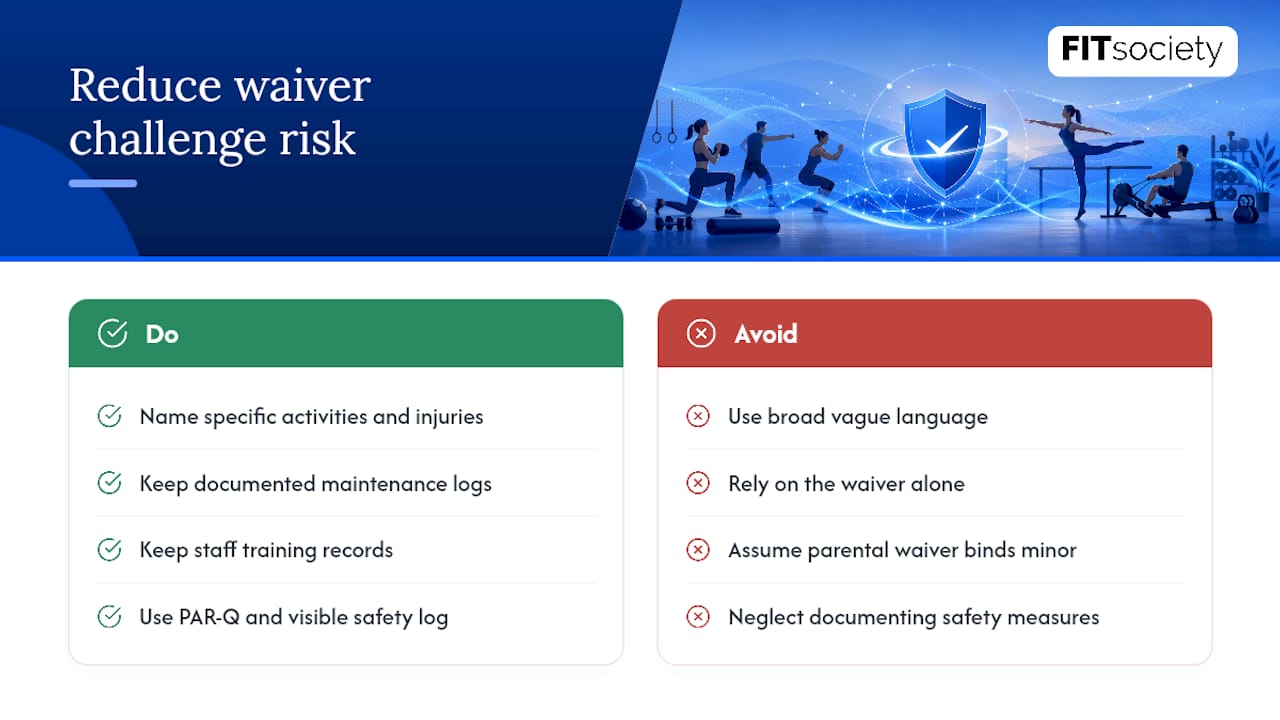
Vague language is the most common failure point. A release covering “all risks of exercise” without naming specific activities gives a courtroom to find the client wasn’t genuinely informed. The fix is straightforward: name activities and injuries explicitly, as covered in the core-elements section above.
Unconscionability arguments surface when a facility uses a waiver to disclaim responsibility for something a reasonable person wouldn’t expect, unmaintained equipment, untrained staff, unsafe premises. A documented maintenance log and staff training record gives a court evidence that you exercised reasonable care independent of the waiver, which matters because gross negligence claims often turn on exactly this kind of documentation.
Minors present a structural problem rather than a wording problem. In several jurisdictions, a parent’s signature on a liability waiver doesn’t fully bind the minor once they reach adulthood, and some courts have voided parental waivers outright for injuries to children. Facilities serving youth programs should treat this as a known limitation, not an oversight to fix with better phrasing, and confirm local rules with an attorney familiar with youth-liability statutes specifically.
The strongest mitigation across all three challenges is the same: pair the waiver with a documented PAR-Q health screen and a visible operational safety record, so the waiver isn’t your only evidence of reasonable conduct.
General Fitness Waivers vs. Specialized Class Waivers
A general gym membership waiver and a hot yoga class waiver shouldn’t read the same way, because the named risks are different, and treating them identically is one of the more common enforceability gaps facilities create for themselves.
A standard gym liability agreement covering open-floor access needs to name equipment-related risks: dropped weights, machine misuse, cardio-equipment falls, and general muscle strain. That’s a broad but finite risk set tied to self-directed training.
Specialized classes carry named risks a general waiver never anticipates. Hot yoga introduces heat-related illness and dehydration risk that a standard release doesn’t cover. Aquatics programming introduces drowning risk. Olympic-style lifting or CrossFit-style programming introduces higher-velocity injury risk tied to technique and load. A personal training waiver for one-on-one sessions should additionally reference the trainer’s specific role, program design, spotting, hands-on correction, since that direct physical involvement creates a different liability profile than a client working independently on a gym floor.
The practical fix is a modular waiver system: a base release every client signs at intake, plus an activity-specific addendum for any specialized class or service. This keeps your core document clean and readable while still naming the exact risks tied to hot yoga, aquatics, or personal training separately. A facility offering five distinct program types benefits from five short addenda far more than one bloated document trying to cover everything at once.
Balancing Legal Defensibility With Client Usability
Simple, readable waivers get signed and understood; dense ones get skimmed and challenged later. The real tradeoff isn’t legal thoroughness versus speed. It’s clarity versus clutter. Digitizing the process, with clean layouts and timestamped e-signatures, improves both auditability and the client’s actual comprehension at signing.
— Matthijs
Manage Waivers and Intake Without the Paper Chase
Chasing down unsigned forms at the front desk costs you time and creates exactly the timing gap that voids a waiver in court. FITsociety centralizes digital intake, e-signature collection, and client records into one workflow, so a new client’s waiver, health screen, and training profile all live in the same place instead of scattered across paper folders and email threads.

Automated reminders flag anyone who hasn’t signed before their first booked session, closing the exact gap that makes so many waivers unenforceable. Combine that with FITsociety’s coaching tools for client onboarding, and your intake process stops depending on front-desk memory. Explore the FITsociety platform and see how digital forms fit into your existing client workflow.
Sources
- Release of liability | LawDepot
- Free Gym Release of Liability Waiver USA 2026 | Forms-Legal
- Release of Liability Agreement | NSCA
FAQ
What Is a Liability Waiver for Fitness?
It’s a signed document in which a client accepts the inherent risks of exercise and releases the trainer or facility from liability for injuries caused by ordinary negligence, though not gross negligence or willful misconduct.
What Is a Liability Waiver for a Fitness Center?
It’s the same core document applied to facility-wide use: covering equipment risk, class participation, and general floor access, typically signed once at membership start and updated when new high-risk programming is added.
How Does a Liability Waiver Work?
The client reads and signs the document before participating, acknowledging specific named risks; if an injury later occurs from ordinary negligence, the signed waiver serves as evidence the client accepted that risk in advance.
Do Digital Waivers Hold Up the Same Way as Paper Ones?
Yes. E-signatures with secure timestamps are widely accepted and, when properly stored, are often more defensible than paper forms because the execution date and client identity are recorded automatically. Platforms like FITsociety build this timestamping into the intake process.
What Happens if I Don’t Pay My Gym Debt?
That’s a separate contractual issue from a liability waiver. Unpaid membership dues typically fall under your membership agreement’s collections terms, not the liability release, and can result in collections action or credit reporting depending on the contract you signed.